History
Monterey: California's First Capital and the Street Named for Sardines
A lot of people know Monterey for the aquarium and Cannery Row. Fewer know that for most of its first 80 years, Monterey was the most important town in California. Walk through downtown and you'll pass adobes, a customs house, and the hall where California's first constitution was written, all within a few blocks of each other.
A capital before California was a state
The first European to land here was Sebastián Vizcaíno in 1602, who named the bay after the Count of Monterey. But nothing permanent happened until June 3, 1770, when the Spanish founded the Royal Presidio and a mission here.
The mission didn't stay long. In 1771, Father Junípero Serra moved it to Carmel, where it still stands today. The Presidio stayed in Monterey as the seat of government, and in 1776, Spain made Monterey the capital of California.
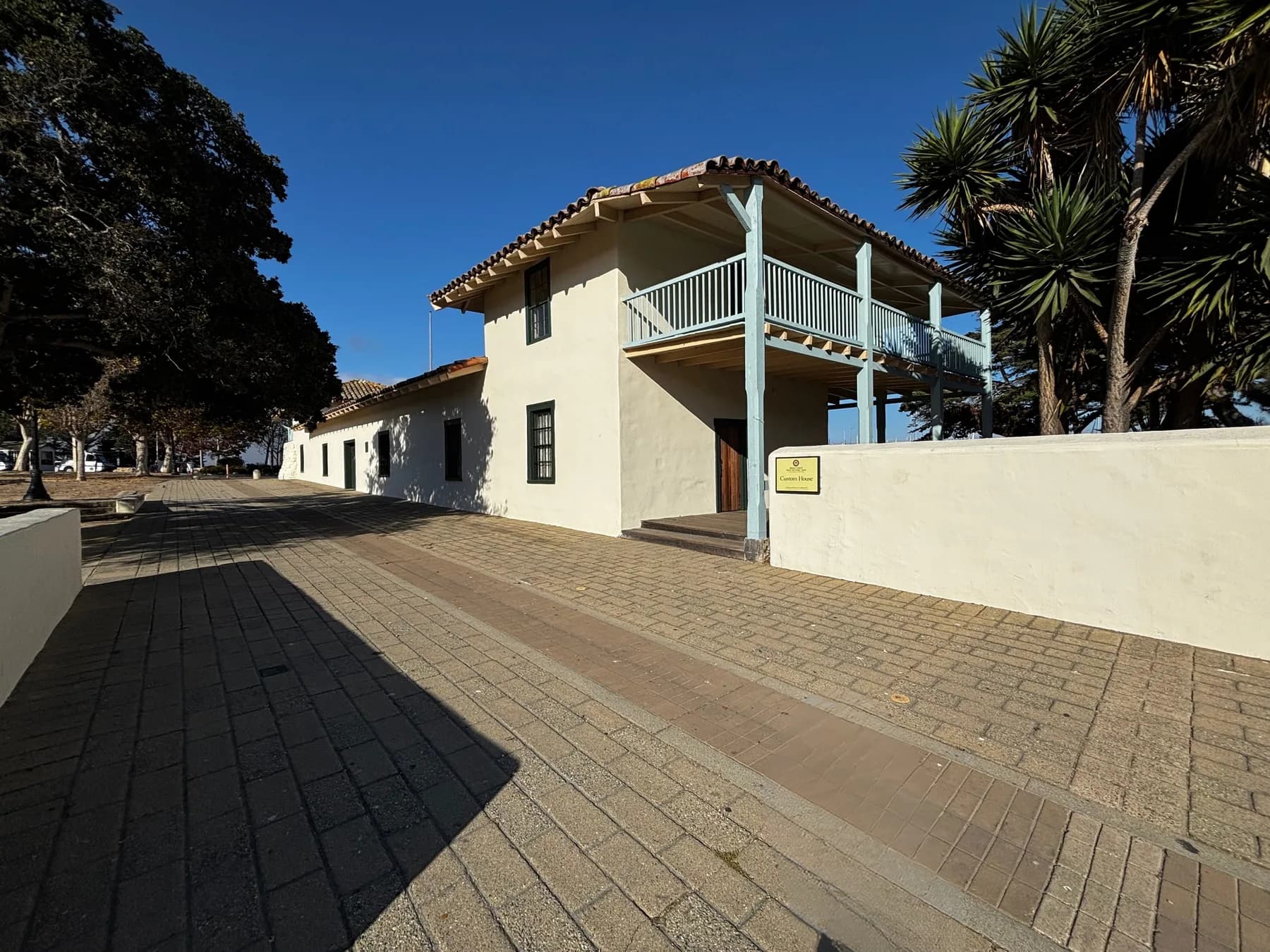
Monterey stayed the capital under Mexico, too. When Mexico opened California to trade in 1822, Monterey became the official port of entry, and ships had to stop at the Custom House before trading anywhere else. The Custom House is considered the oldest public building in California, and it still stands at the foot of Alvarado Street.
The American flag goes up
On July 7, 1846, during the Mexican-American War, U.S. Commodore John Sloat's troops landed in Monterey and raised the American flag. Two years later, the treaty ending the war made California part of the United States.
In 1849, delegates from across California met at Colton Hall in Monterey to write the state's first constitution. It was ratified that October, and California became the 31st state on September 9, 1850.
After statehood, the state government moved elsewhere, and Monterey was never the state capital. It stayed the county seat until 1873, when that moved to Salinas, and Monterey's political importance faded.
The sardine years
What brought Monterey back was fish. In 1902, the first major cannery opened on Ocean View Avenue, along the waterfront. Others followed, and a cannery manager named Knut Hovden helped turn sardine canning into a fast, assembly-line business.
By the early 1940s, more than two dozen canneries and processing plants lined the street, and they employed somewhere around 3,000 to 4,000 people, close to half the town. Monterey was known as the sardine capital of the world. Locals had been calling the street "Cannery Row" for years, for the simplest reason: it was a row of canneries.
In 1945, John Steinbeck published Cannery Row, a novel set on the street during the Great Depression. Many of its characters were inspired by real people, including his friend Ed Ricketts, a marine biologist who ran a lab on the Row.
Then the sardines disappeared. The catch dropped from about 142,000 tons in 1946 to about 27,000 tons the next year. Overfishing played a big part, along with changes in ocean conditions. Canneries closed one after another through the late 1940s and 1950s, and the last one, the Hovden Cannery, shut down in 1973.
A second life
In 1958, the city officially renamed Ocean View Avenue as Cannery Row, after the book had made the name famous. In 1984, the Monterey Bay Aquarium opened on the site of the old Hovden Cannery, and the cannery's boiler house is still preserved inside.
Today, Cannery Row is mostly restaurants, hotels, and shops, but you can still see pieces of the old canneries along the street.
What it means if you're buying or selling in Monterey
Monterey's long history shows up in its neighborhoods and its rules:
- Historic homes and districts. Monterey has historic zoning and older neighborhoods with homes from many different eras. Changes to historic properties can require extra review, so it's worth checking before you plan a remodel.
- A city report before you sell. Monterey requires a Residential Property Inspection report before most single-family home sales close, plus a sewer lateral inspection. Condos are exempt from the property inspection. See the Seller's Guide chapter on disclosures and local requirements.
- Water. Monterey is inside the Peninsula's water district, so the water fixture rules apply when you sell, and adding a bathroom isn't always simple.
- Short-term rentals. Rentals under 30 days aren't allowed in Monterey's residential areas.
For more on these rules, see the Buyer's Guide chapter on local rules.
Sources: City of Monterey, Early Monterey History; Wikipedia, Cannery Row.
Sources
- City of Monterey, Early Monterey History (Monterey Museums)
- Wikipedia, Cannery Row