Buying
Should You Buy a Home When Mortgage Rates Are High? Marry the Home, Date the Rate
Buying a home when interest rates are high feels scary, especially when everything else around you feels expensive too.
As I write this, the average 30-year fixed rate is 7.24%, according to Freddie Mac. That's a big jump from the 3% rates a lot of people still remember. But rates are only one part of what you pay for a home. The other part is the price, and that's the part a lot of people forget about when they're waiting for rates to come down.
What prices are doing right now
If you've been waiting for prices to drop, here's the honest picture: for regular resale homes, the kind most people buy, they haven't really dropped. They've slowed down.
Nationally, the median price of existing homes sold in September 2026 was $417,500, according to the National Association of Realtors. That's up 1.3% from a year earlier. In June 2026, the median hit an all-time high of $440,600. Prices are still going up, just much more slowly than they were.
Look at how much that growth slowed once rates went up:
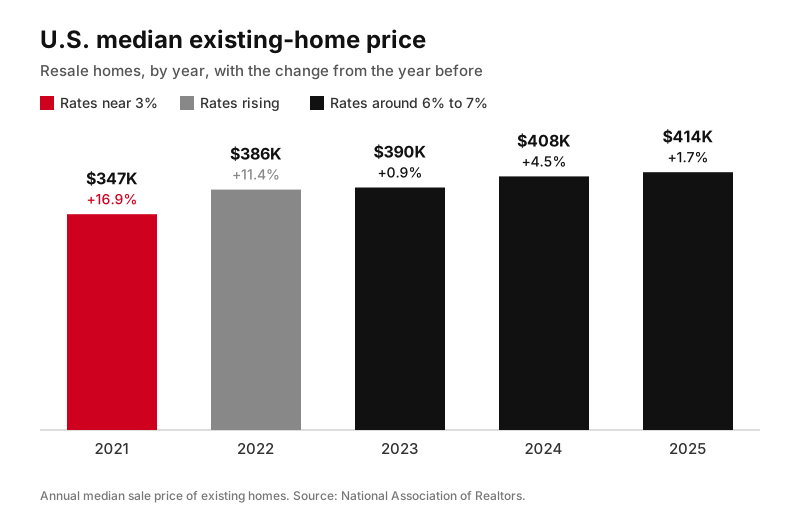
In 2021, with rates near 3%, the median resale price jumped almost 17% in one year. In 2025, with rates between 6% and 7%, it went up less than 2%. Higher rates and everything going on in the world have cooled things down. For buyers who have been on the sidelines, that means less competition, more homes to choose from, and more room to negotiate than a few years ago. Nationally, there were about 4.8 months of supply in September, up from 4.5 months a year earlier.
Here in Monterey County, our market doesn't really follow national trends, but the pattern is similar. The median sale price here is up nearly 8% since 2022, from $835,000 to $900,000, but it has barely moved since 2024.
Santa Cruz County is a little trickier. Its median sale price is down a little over 4% since 2022, but it's up a little over 9% since 2021. It's been a choppy market. The median jumped from $1.05 million in 2021 to $1.2 million in 2022, dropped to $1.13 million in 2023, jumped again to $1.19 million in 2024, and has been trending down a little since.
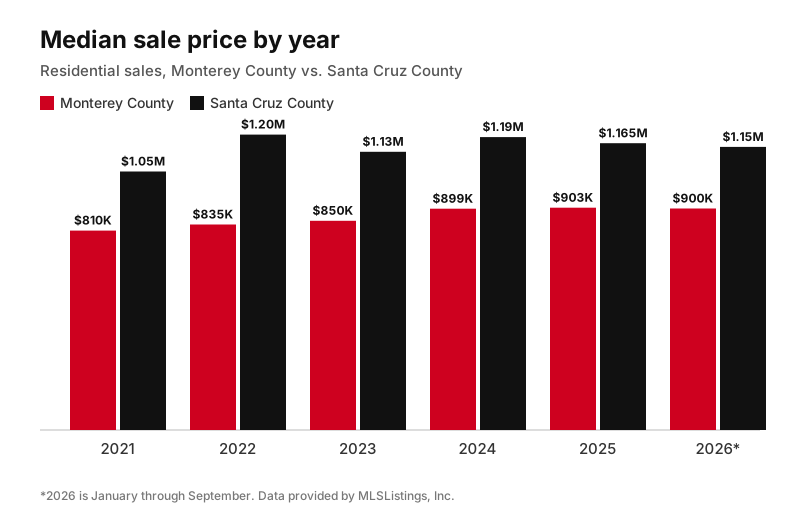
Residential sales, January 2021 through September 2026. Data provided by MLSListings, Inc. Medians change over time, and the mix of homes that sell in a given year can move them.
In both counties, prices have mostly flattened out over the last couple of years. They aren't racing up the way they did when rates were at 3%, and buyers have more room to negotiate than they did then.
How rates have affected resale prices
To see how rates and resale prices have moved together over time, I compared Freddie Mac's 30-year mortgage rate with the S&P CoreLogic Case-Shiller U.S. National Home Price Index going back to 1988. Case-Shiller is the standard way to track resale home prices. It follows the same homes each time they sell, so it isn't thrown off by new construction or by the mix of homes selling in a given month.
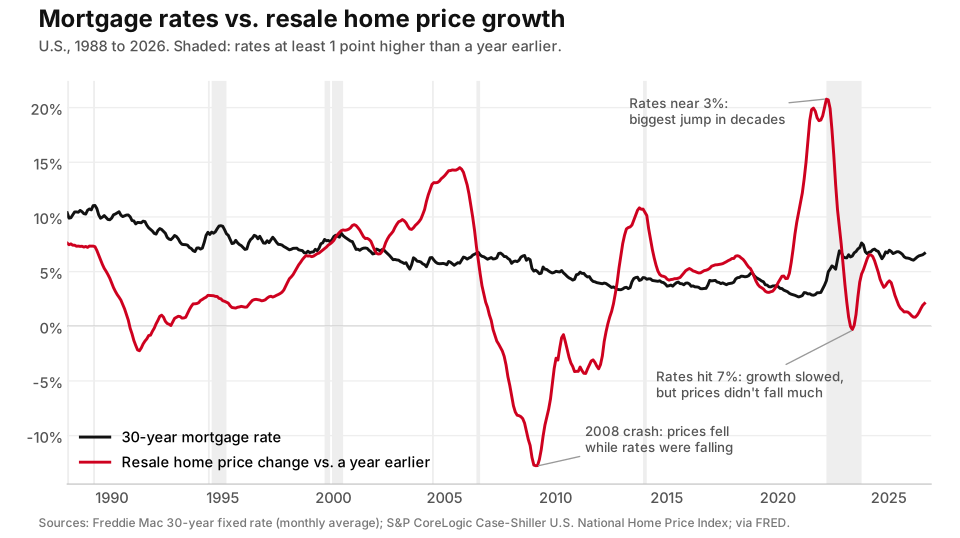
Here's what the numbers show:
- Low rates came with the biggest jump in decades. With rates near 3% to 4%, resale prices were up almost 21% from a year earlier by early 2022.
- When rates hit 7%, price growth slowed, but prices didn't fall much. Growth dropped from 18% a year in mid-2022 to about zero by spring 2023. At its lowest, prices were down just 0.3% from a year earlier. Then they started climbing again, and they set new highs in 2026.
- Buying at the "worst" time still worked out. Someone who bought at the June 2022 peak, right as rates were jumping, has seen the national index go up about 9% since. Someone who bought in early 2023, with rates over 6%, has seen it go up about 15%.
- The biggest drop had nothing to do with high rates. From 2006 to 2012, resale prices fell about 27%, during the credit crash. Rates were falling the whole time, from about 6.8% to 3.9%.
- Rates and prices don't move in lockstep. Over the whole period, there's almost no direct relationship between how high rates are and how fast prices grow. Rates affect how many people can buy, but prices also depend on jobs, inventory, lending rules, and how many people want to live somewhere.
So the honest version is this: high rates have slowed resale price growth, sometimes to almost nothing, but they haven't usually made prices fall. Waiting for rates to drop hasn't usually gotten people a better price. These are national numbers, and Monterey County doesn't always follow national trends, but the local data above shows the same pattern: fast growth when rates were low, and flat prices since.
Is the market going to crash?
I hear this one a lot. Some people expect a crash like 2008. The data I'm seeing looks a lot more like a correction than a crash.
The things that caused 2008 aren't really here right now:
- Lending is stricter. The risky loans that crashed the market, like loans with no proof of income and adjustable rates that jumped on people, are mostly gone. Banks have much stricter requirements now.
- Many homeowners don't owe much, or anything. According to the Census Bureau, nearly 40% of U.S. homeowners didn't have a mortgage in 2024.
- Many homeowners have low rates. About half of all mortgages in the U.S. still had a rate under 4% at the end of 2025, according to FHFA data. People who bought before 2020 also have a lot of equity. Most of them aren't in a hurry to sell, and very few are being forced to.
- There aren't many homes for sale here. Monterey County has very few homes for sale for the number of people who live here, and buyers keep coming, including a lot from the Bay Area.
A crash usually needs too many homes for sale, homeowners who owe more than their homes are worth, and loan payments jumping on people all at once. Right now, the numbers don't really add up to that.
That said, this is my read of the data, not a prediction. Nobody knows for sure what the market will do. So let's get back to the main point: why now can be a good time to start looking.
Why buying when rates are high can work in your favor
When rates are high and money is expensive, fewer people are motivated to buy. Everyone wants to buy when rates are cheap.
Sometimes people tell me they wish rates could be 3% again. I ask the obvious question: "Why didn't you buy when rates were 3% before?" The answer is almost always the same. "Prices were going up too much." Or, "We kept getting outbid, and we got discouraged."
It's the same story every time. When rates are low, everyone wants to buy a house, so competition goes up, and prices follow. The whole point of a lower rate is a lower monthly payment. But if prices keep rising, they can cancel out the savings from the lower rate.
And around here, waiting usually costs you something either way. When the market is hot, prices go up a lot. When it's cold, they stay flat or go up a little. Time is the enemy until you own. Then it becomes your friend.
Two buyers, two years apart
Here's how I think about it. When you buy in a high-rate market, the biggest con is the higher rate. But look at the pros:
- A softer market. Less competition means you're less likely to overpay or get into a bidding war, and you have more room to negotiate.
- You're paying down your loan. Every month, you owe the bank a little less, and your equity grows.
- You get the appreciation. Over that same time, prices usually keep rising, and that growth is yours.
- You can refinance later. If rates come down, you can refinance to a lower payment, while everyone else is just getting into the market and paying more.
Buying when rates are low is the opposite. The pro is the lower rate. The cons are more competition, more bidding wars, less room to negotiate, and higher prices. And if you already have a low rate, there isn't much room for it to go lower.
Here's a simple example with round numbers. It's an illustration, not a forecast.
Buyer 1 buys now. The home costs $850,000. They put 20% down and get a 7% rate. Their monthly principal and interest is about $4,524.
Buyer 2 waits two years for rates to drop to 6%. By then, with more buyers back in the market, a similar home costs 10% more, about $935,000. (For comparison, national resale prices rose about 30% in the two years from 2020 to 2022, when rates were low.) They put 20% down too, so they need about $17,000 more for the down payment. Their monthly principal and interest is about $4,485.
After all that waiting, Buyer 2's payment is almost exactly the same as Buyer 1's. But in those two years, Buyer 1 paid down their loan by about $14,000, and their home went up in value along with everyone else's. Buyer 2 is starting from scratch, with a bigger loan.
And if rates do drop to 6%, Buyer 1 can refinance. On their new, lower balance, a 30-year loan at 6% would be about $3,991 a month, before the cost of refinancing.
Payments are principal and interest only, on a 30-year fixed loan. They don't include property taxes, insurance, or other costs, and real numbers depend on the home, the loan, and the market.
You can always change your rate. You can never change the price you paid for the house. As Warren Buffett put it, be "fearful when others are greedy" and "greedy when others are fearful."
Don't count on the refinance
I want to be honest about this part. Refinancing is a possibility, not a promise.
Rates don't always come down when we want them to. Someone who bought in late 2022 at around 6.7% hasn't had a great chance to refinance yet. Rates got close to 6% earlier this year, and as I write this, they're back above 7%.
History is more encouraging than that, but with a catch. Going back to the late 1980s, people who bought when rates were high compared to the previous five years almost always saw rates drop at least a full point within five years. But that period includes a 40-year stretch when rates were falling overall, from around 18% in 1981 to under 3% in 2021. That may not repeat.
Refinancing also costs money, often a few thousand dollars or more, so a small drop in rates may not be worth it.
So the most important thing is this: buy a home with a payment you can live with today, at today's rate. If rates come down, that's a bonus. If they don't, you're still in a home you can afford.
Ways to make a higher rate easier
- Ask for seller credits. In a softer market, sellers are more open to paying some of your closing costs or helping buy down your rate. How much a seller can pay depends on your loan program. See Chapter 8 of the Buyer's Guide for more on offers.
- Look at builder incentives. Builders of newer homes sometimes offer rate buydowns or help with closing costs. Ask what's available, and compare it to what you'd get on a resale home.
- Shop your lender. Rates and fees can be different from one lender to the next. A good lender can also walk you through options like a temporary buydown. See Chapter 4 of the Buyer's Guide for more on financing.
- Get pre-approved first. Knowing your real numbers takes a lot of the fear out of it.
When waiting might make sense
Buying isn't the right move for everyone right now. Waiting can make more sense if:
- You might move again in the next few years. Buying and selling both cost money, and it takes time to make that back.
- The payment would stretch your budget too thin, even before taxes, insurance, and repairs.
- Your income or job situation is uncertain.
- You don't have savings left over for emergencies after your down payment and closing costs.
Marry the home, date the rate
If you've been thinking about buying a home and want to get ahead of the curve, now may be your time. Yes, you'll live with a higher rate for a while. But in the long run, it can be better than competing with everyone else once rates drop and they all jump back in.
As they say, marry the home, date the rate.
If you want to talk through your numbers, or get connected with a lender who can show you what your payment would look like, reach out. I'm happy to help, even if you're just starting to think about it.
Extra data: newly built homes
Everything above is about resale homes. This section is for anyone who wants to dig deeper into newly built homes, which behave a little differently.
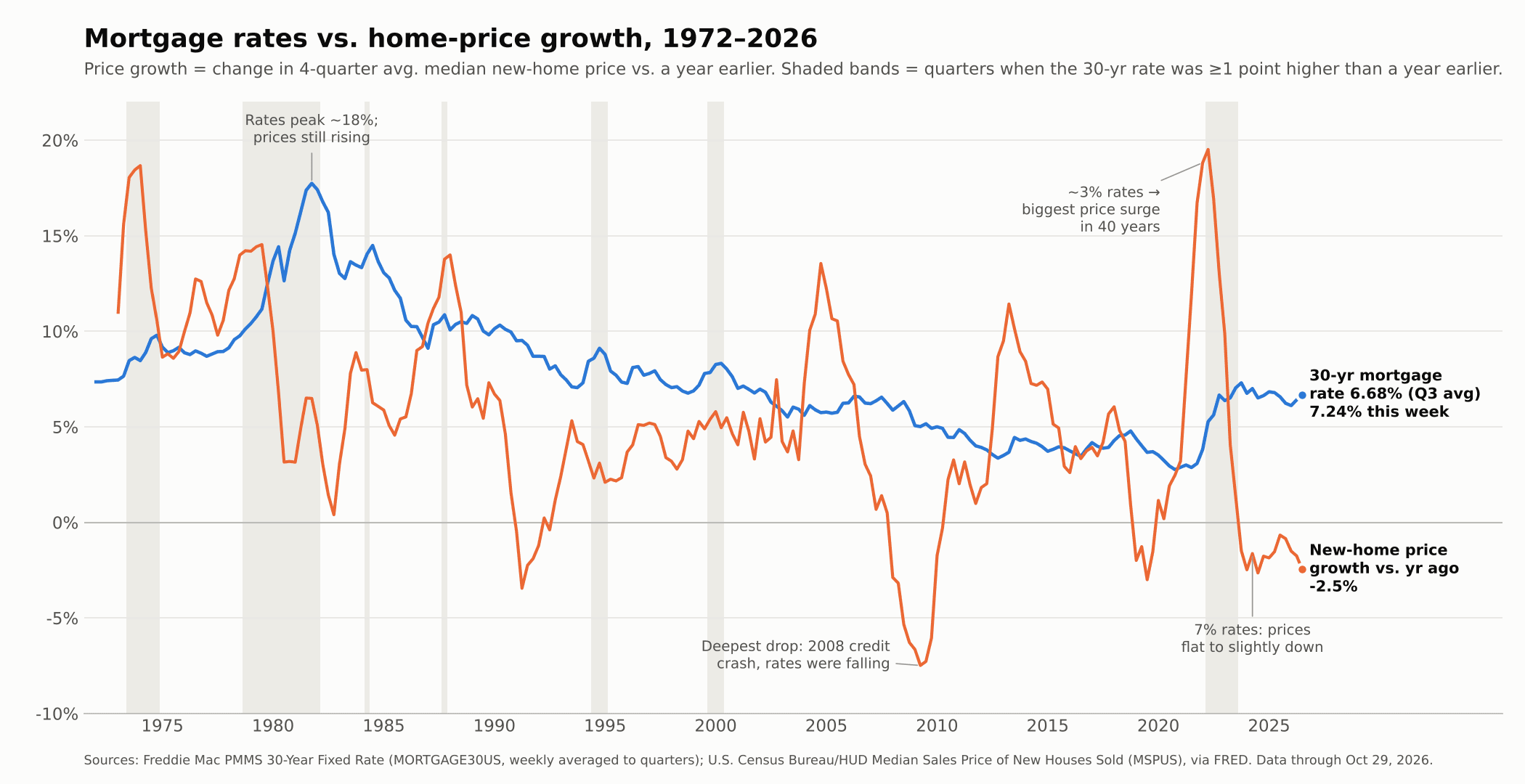
New-home prices have dropped. The median price of new homes sold in the U.S. peaked at $442,600 in late 2022. In the third quarter of 2026, it was $393,300, about 11% lower. Part of that is builders offering more incentives and building smaller homes, which pulls the median down. It's also why the builder incentives I mentioned above are worth asking about.

The same pattern in new homes. New-home prices go back even further, to the early 1970s. Comparing them with mortgage rates shows the same story as resale homes: in 1981, rates were near 18% and new-home prices still went up, and the biggest drop came in 2008 and 2009, while rates were falling.
Last checked: October 29, 2026. Mortgage rate from Freddie Mac's Primary Mortgage Market Survey, week of October 29, 2026. National resale data from the National Association of Realtors and the S&P CoreLogic Case-Shiller U.S. National Home Price Index. New-home data from the U.S. Census Bureau and HUD, via FRED. Local data from MLSListings, Inc. This is general information, not financial advice. I'm a real estate agent, not a lender or financial advisor. Talk to a lender about your own situation.
Sources
- Freddie Mac, Primary Mortgage Market Survey (week of October 29, 2026)
- National Association of Realtors, Existing-Home Sales, September 2026 (October 13, 2026) and annual median existing-home prices, 2021 to 2025
- U.S. Census Bureau and HUD, Median Sales Price of New Houses Sold for the United States (MSPUS), via FRED
- Freddie Mac 30-year fixed rate (MORTGAGE30US), via FRED
- S&P CoreLogic Case-Shiller U.S. National Home Price Index (CSUSHPINSA), via FRED, through August 2026
- MLSListings, Inc., median sale price by year, Monterey County and Santa Cruz County residential, January 2021 to September 2026
- U.S. Census Bureau, Nearly 40% of U.S. Homeowners Did Not Have a Mortgage in 2024 (January 2026)
- FHFA National Mortgage Database, outstanding mortgage rates, Q4 2025 (via Wolf Street, March 2026)