
Selling
The Longer It Sits, the Longer It Sits: What Overpricing Costs Monterey County Sellers
Every seller wants the most money for their home. That's fair. But one of the most common ways sellers lose money is by asking for too much at the start.
As I write this, I'm seeing a lot of homes around the county come on the market too high and then cut the price. The numbers show what that usually costs.
What the numbers show
This chart breaks down Monterey County sales so far this year by how long each home sat on the market. It compares the final sale price to the original list price.
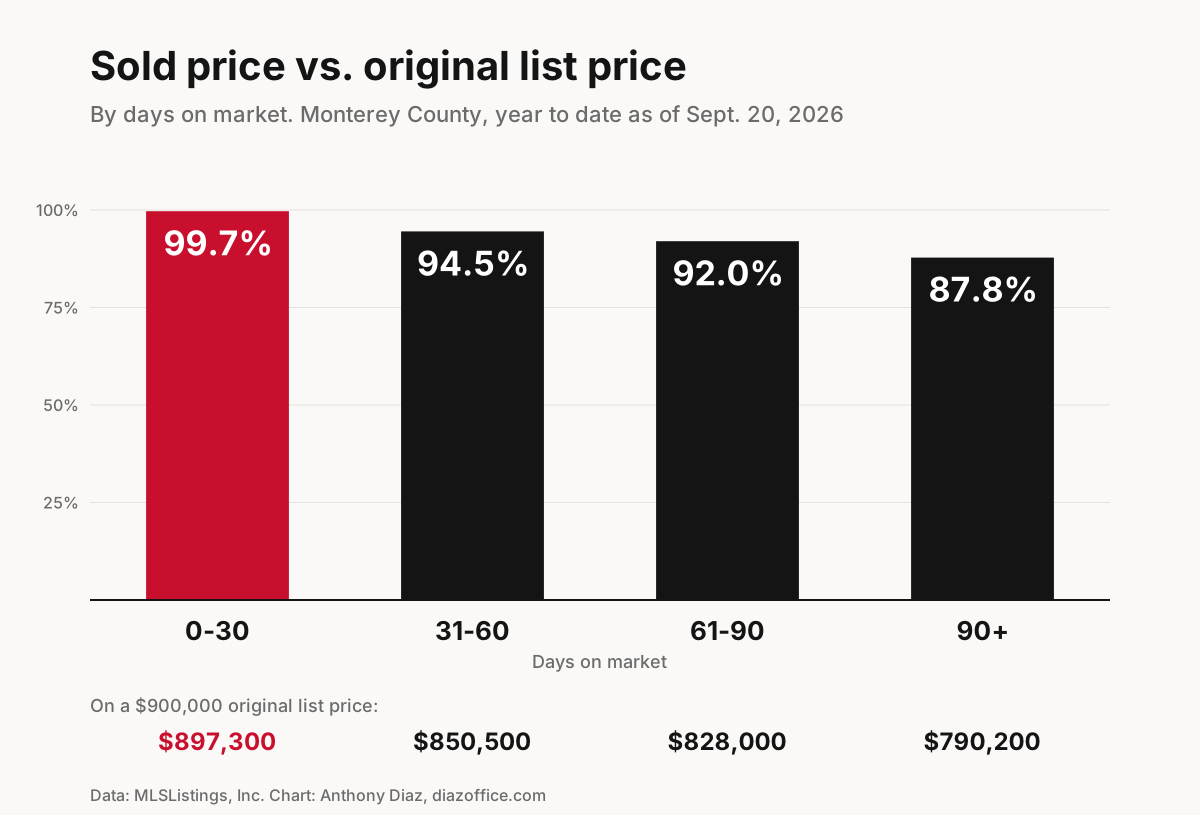
- 0 to 30 days: 99.7% of the original list price
- 31 to 60 days: 94.5%
- 61 to 90 days: 92.0%
- 90+ days: 87.8%
The word "original" is important. When a listing gets a price cut, the new, lower price becomes the list price. So a home can sell at "full price" after two price cuts and still sell for less, or a lot less, than the seller asked for originally. Comparing to the original price tells us more than the most recent list price.
Here's what those percentages look like on a home first listed at $900,000:
| Days on market | Sold for about |
|---|---|
| 0 to 30 | $897,300 |
| 31 to 60 | $850,500 |
| 61 to 90 | $828,000 |
| 90+ | $790,200 |
That's a difference of more than $100,000 between a home that sold in its first month and one that sat for three.
It's price for the condition
Price doesn't work on its own. Buyers pay for condition and location. A home in excellent shape in a great spot can sell above what the nearby sales suggest. A home that needs work, priced like it doesn't, will sit. That's why I price from comps: recent sales of similar homes show what buyers have actually paid for that condition, location, and size.
Not every home that sits is overpriced, either. I recently showed a home that felt priced right for its condition, location, and size, and it's still sitting. Maybe it's bigger than most buyers in that neighborhood want. Maybe it needs a little updating. Sometimes it's hard to say, especially in this market.
As I write this, mortgage rates are still higher than what many buyers got used to a few years ago, and there's a lot happening in the world. That can make buyers hesitant. Many take their time, compare more homes, and wait for the right one at the right price. When buyers are this careful, pricing right from the start is even more important. A home that's priced a little high can easily get passed over for a similar one down the street that's priced right.
But when a home sits, price is usually the reason. And the choices a seller makes once offers come in can matter just as much as the list price.
The longer it sits, the longer it sits
A new listing gets the most attention it will ever get in its first couple of weeks. Buyers get alerts. Agents bring their clients. People who have been waiting for the right home come see it right away.
If the price is too high, that first wave of buyers passes. Then the listing starts to age, and the buyers who come later start asking different questions:
- Why is it still on the market?
- Is something wrong with the house?
- Are the sellers hard to deal with?
Even a good home starts to look like a problem. Fewer buyers book showings. The ones who do come in often offer lower, because they figure the seller is ready to make a deal. A listing that has sat for a while also starts to attract bargain hunters. Each price cut can make the next buyer wonder if another one is coming.
That’s the compound effect. The longer a home sits, the more buyers assume something is wrong with it, even when nothing is. In the end, many overpriced homes sell for less than they would have gotten if they had been priced right on day one.
Two stories I think about
A couple of years ago, a house came on the market priced well above what the sales nearby supported. It had some quirks. Not every buyer would love it.
Then, right away, a buyer showed up who loved it for exactly what it was. They made a full-price offer. The seller was told this was likely the best offer they would get.
The seller was out of town and decided to wait for more offers. It's an easy decision to understand. A quick full-price offer can feel like a sign you priced too low.
The other offers never came. That buyer moved on. The house was relisted a couple of times at prices more than $100,000 lower than the first one. It went months with hardly any showings and no offers, and it was eventually taken off the market.
You'll often hear "it only takes one buyer." That's true. But for an overpriced home, that one buyer is rare, and when they show up early, the clock is already working against you. A house priced at fair value could have drawn several buyers, maybe even competing offers.
I've seen the same thing from the buyer's side. Back when the market was hotter, I wrote an offer on a home listed at $749,000. We offered the full asking price. The seller countered for more. My buyers said no and moved on. The home sat on the market and eventually sold for far less than $749,000.
In both cases the seller had the buyer they were hoping for. What cost them was what happened next.
What to do instead
- Price from the sales, not from hope. Recent sales of similar homes nearby are the best guide. What a neighbor is asking, or what an online estimate says, can be very different from what buyers actually paid.
- Take the first two weeks seriously. If a home gets showings but no offers, or very few showings at all, the market is giving you feedback. Adjusting early usually costs less than adjusting late.
- Take strong early offers seriously. An early offer near your asking price usually means you priced it right. It doesn't automatically mean you priced it too low.
- Think hard before countering a full-price offer for more. The buyer can always walk away, and the next offer may be lower.
I cover how pricing works in more detail in Chapter 3 of my Seller's Guide.
Want to know what your home would sell for?
If you're curious what your home would sell for in this market, reach out. I'd be happy to help you.
Last checked: October 15, 2026. Market data is for Monterey County, year to date as of September 20, 2026, from MLSListings, Inc. Results for any one home depend on its condition, location, and the market at the time. This post is general information, not a valuation of your home.
Sources
- MLSListings, Inc. Monterey County sold price to original list price ratio by days on market, year to date as of September 20, 2026.
Sources
- MLSListings, Inc., Monterey County sold price to original list price ratio by days on market, year to date as of September 20, 2026